

Building Understanding When Data Alone Can’t Tell the Story
Inside the Innovation Foundation’s human-centered approach to understanding workers often left behind.

It was an unusually hot day in London during a heat wave steaming through the city. We weren’t sure we’d see anyone walk through the doors that day — not with that heat, and not considering that the people we’d invited would mostly be traveling in from the outer parts of the city. If you know London, you know that’s a real ask.
But at the top of the hour, one by one, they came. Humidity-fluffed hair, sweat glistening on their skin, and huge, genuine grins on their faces. Every single one of them said some version of the same thing as they walked in: I’m so glad to be around people who get it.
They were there because their experiences mattered.
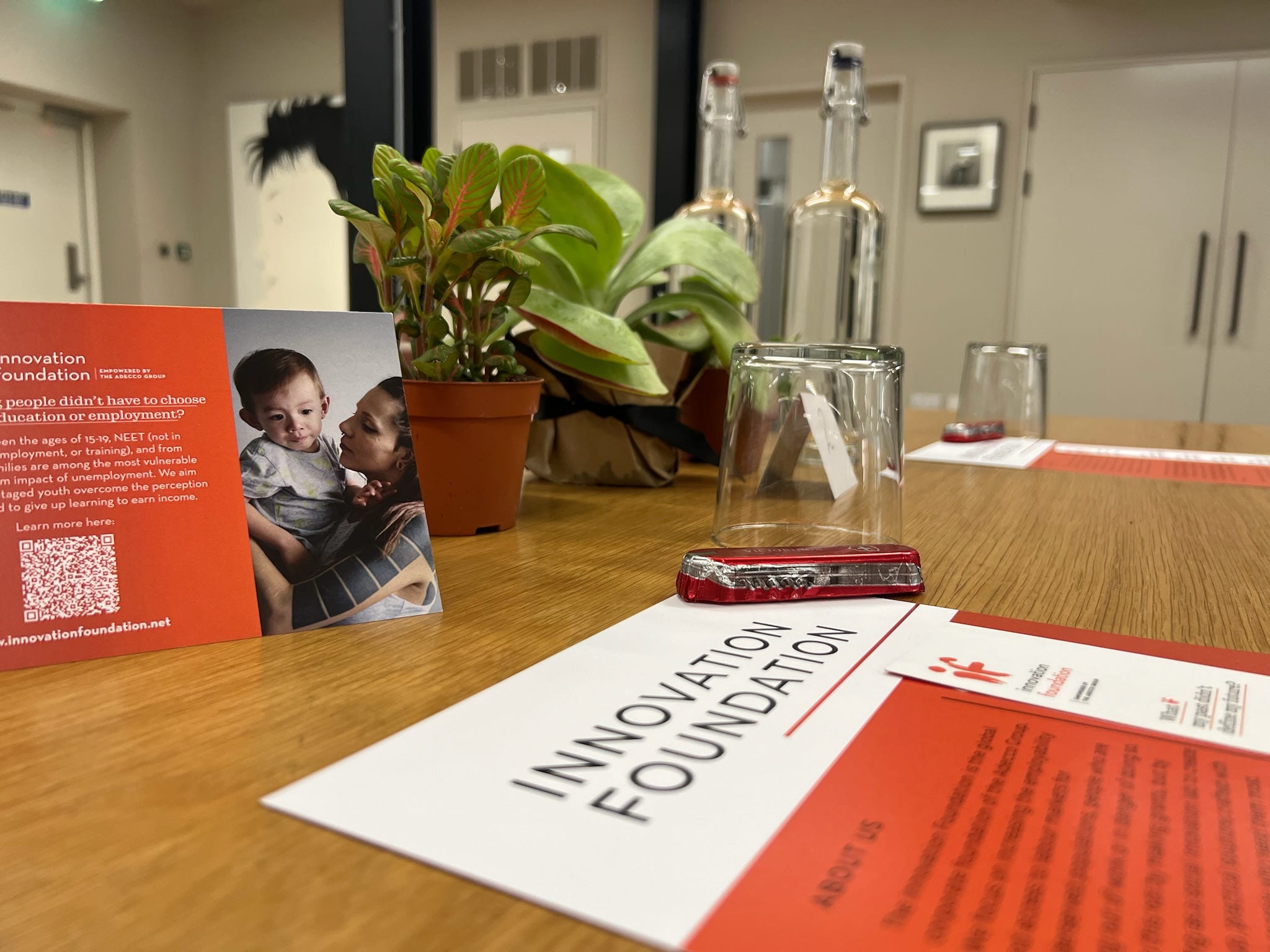
The Innovation Foundation, the global corporate foundation to The Adecco Group, serves as a Social Innovation Lab that supports sustainable livelihoods. In its work with underserved populations, the Foundation increases employability and access to labor markets.
That’s a bold model, and building it meant pushing beyond data gathering, into a process that earned trust so that researchers could develop and deploy the right solutions with the right partners locally. They needed to create a space where these voices could truly shape things.
That’s where &Human came in.
When Stories Demand Trust
The Innovation Foundation’s research team wasn’t doing anything wrong.
They were asking thoughtful questions and doing the work with care. But there was a gap they needed to close in order to build their model right, the trust gap that exists when a community has historically been studied, but still underserved.
In this instance, the community was people who identified themselves as “mature workers.” These are professionals in their 50s and 60s and navigating something nobody prepared them for; they thought they’d be mentoring the next generation and applying the depth of their experience to new innovation. Instead, they found themselves overlooked, dismissed, unemployed, underemployed, or slowly pushed toward the edges of industries they’d spent decades building.
With populations like this, the trust gap only widens when people can feel when they’re being extracted from—a sensation that many traditional research models can accidentally create.
People sense when their story is being collected rather than heard. It registers somewhere in the body before the brain has the words for it and when that happens, you don’t get the real story. You get the safe version, the facts without the emotion and personal impact.
This meant that in order to gather rich, meaningful qualitative data, The Innovation Foundation’s research team needed to create that “I’m so glad to be around people who get it” feeling I mentioned earlier.
Some might even call it connection.
Connection is Infrastructure and You Have to Design for It
Before designing the research session, we started by focusing on the researchers themselves, working through what I’d describe as connection-first facilitation.
Where the team previously managed the agenda and performed “intake,” they learned the art of following the thread of a conversation. Before you can hold space for someone else’s story, especially someone whose life experience is entirely different from your own, you have to know how to be present in a room. We focused on skills that built presence: how to listen for what’s underneath the answer, and how to navigate the status dynamics and emotional weight.
Once the team mastered that, they were ready for that room in London.
Combined with a small-group format of 3-6 participants per researcher and a redesigned question architecture, presence and connection-first facilitation allowed the researches to go somewhere real.
What I watched happen in those researchers was something I never get tired of seeing.
From Collecting Data, to Listening for The Story Worth Hearing
They leaned in. The way you lean in when you’re genuinely pulled toward something because the people across from them were doing the same.
Participants who walked in guarded would slowly, visibly let go, their shoulders dropping, face softening as they found words for the micro-moments that added up to the larger feeling of being on the outside looking in at a career they’d spent years building. And then the laughter. Oh my gosh, the laughter. The kind that pulls a room together when two strangers realize they’ve been carrying a similar weight.
The researchers learned to notice what wasn’t being said as much as what was. They learned that a laugh, a pause, a glance across the table are data points too. Once you’ve been in that kind of room, it changes what you’re willing to settle for.
What started as a workshop for a small research team was designed not just to transform that room, but to scale. The Innovation Foundation is now building out a global program to train facilitators and researchers in empathetic data collection—this is the approach &Human builds into every project:
Designing for human connection, scalable learning, and impact that lasts when our team is no longer in the room.
If you’re a leader who wants to create spaces where communities feel truly heard, so that you can design solutions in partnership, our upcoming Connection Design Lab will give you the frameworks and skills to hold groups together, no matter what the stakes or tension.
Excellent approach. The story behind the data, and the human aspects of it, really need to be understood.